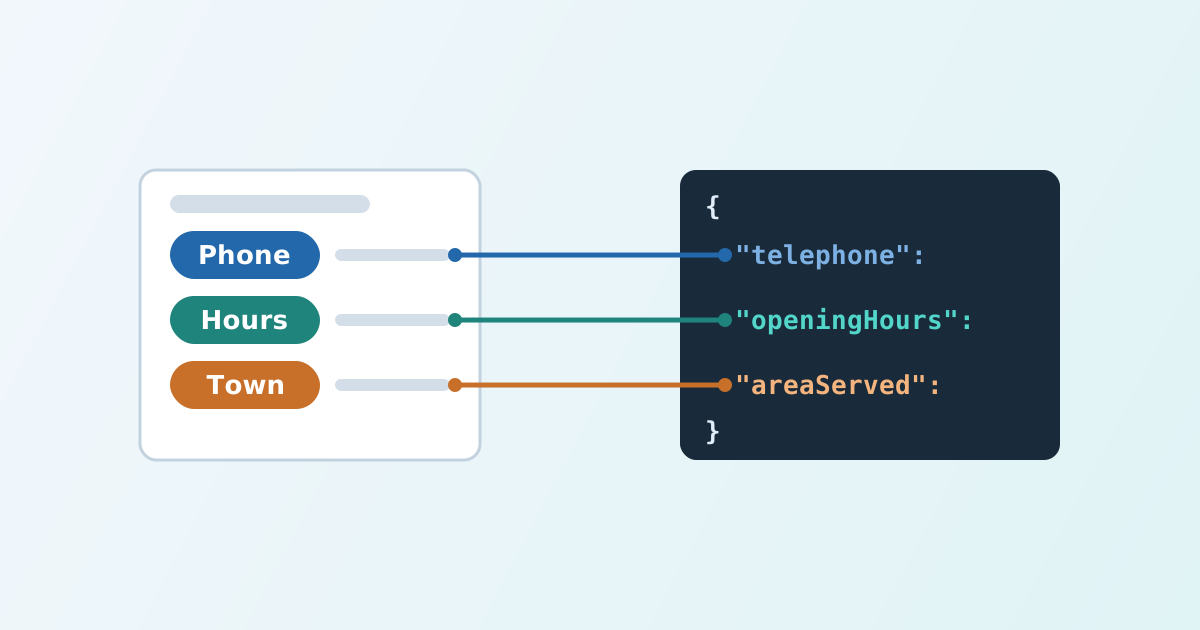
JSON-LD is the thing that puts your business details in a form machines read without guessing: your name, phone, hours, the towns you serve, and the work you do, written as a short block of code in your page that visitors never see. Search engines read it, and so does anything else that reads your page’s code rather than its layout. Plenty of small business sites have none. Others have a block a plugin wrote years ago that now disagrees with the page: an old phone number, hours that changed, a review score with no reviews behind it. Let’s look at what you already have. Then we write markup that says exactly what your page says, and check it the way Google does.
What JSON-LD is#
JSON-LD stands for JavaScript Object Notation for Linked Data, a W3C standard
format. On a website it carries a description written in the schema.org
vocabulary: the shared set of names, such as LocalBusiness, Service,
openingHours, and areaServed, that the major search engines started in
2011 so they could all read the same thing. Schema is the vocabulary; JSON-LD
is the format Google recommends for writing it into a page. It sits in the
page’s code, not on the screen, so it changes nothing a visitor sees.
Why it matters, and what it does not do#
- Your facts are stated, not inferred. Without it, a search engine works out your hours and service area from how the page looks. With it, they are written down in the format it was built to read.
- It is how a page qualifies for some search features, such as breadcrumbs under your listing. Google is clear that markup makes a page eligible and guarantees nothing; it decides what to show.
- It has to tell the truth. Markup must describe what the page itself shows. Markup that claims something the page does not, such as a rating with no reviews on the page, breaks Google’s structured data rules and can bring a manual action against the site.
- Some old promises no longer apply. Google stopped showing review stars for a business’s reviews of itself in 2019, and since 2023 it shows FAQ results only for a small set of government and health sites. FAQ markup is still worth having where the page has real questions; it just will not change how your listing looks.
An example from this site#
This is the markup on our own local search service page, trimmed to two of the fifteen towns it lists:
{
  "@context": "https://schema.org",
  "@type": "Service",
  "name": "Local Search and Business Listings",
  "serviceType": "Local search optimization",
  "url": "https://frazemarketing.com/services/local-search/",
  "areaServed": [
    { "@type": "City", "name": "Allen" },
    { "@type": "City", "name": "Plano" }
  ],
  "provider": { "@id": "https://frazemarketing.com/#business" }
}
Read it top to bottom: this page is a Service, here is its name and what
kind of service it is, here is where it is offered, and here is who provides
it. That last line points to one description of the business, written once
for the whole site, so every page agrees about our name, phone, and address.
This page you are reading carries the same kind of block.
What this service covers#
First the read. We run your pages through Google’s Rich Results Test and the Schema Markup Validator, and you get in writing what is there, what is wrong, and what is missing. Then the markup:
- one business description for the whole site, with the most specific truthful type for your trade
- a
Serviceon each service page, pointing back to that business - breadcrumbs, and the dates each page was published and last changed
FAQPageonly where the page really carries questions and answers
On a site we build, every value comes from one record of your facts, the same record the page text uses, so a changed phone number changes everywhere at once and the markup cannot drift from the page. The same record also feeds the site’s llms.txt, the plain summary we publish for AI tools.
How pricing works#
It is part of every site we build. For a site someone else built, it goes into the same monthly arrangement as the rest of our work, and the figure comes in writing after the first call.
“Will schema get us the stars in Google?”#
Not for your own reviews. Google stopped showing those stars for a business’s reviews of itself in 2019, and markup claiming a rating your page does not show breaks its rules. The stars people see beside your name come from your Business Profile, which is why our local search work starts there, and why getting reviews the honest way matters more than any markup.