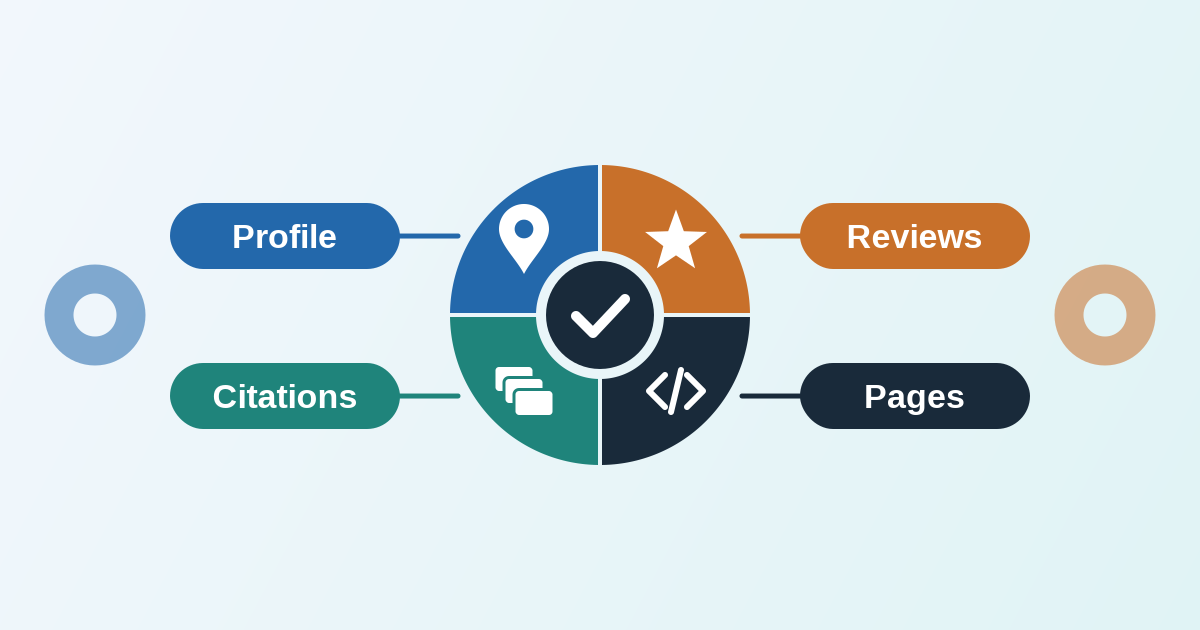
“Local SEO services” is one of those phrases that can mean almost anything, which is convenient for the people selling it and inconvenient for you. The work behind an honest version of it is not mysterious, and once you can name the pieces you can read any quote and see what is actually being offered. There are four of them: your Google Business Profile, the other places your business is listed, your reviews, and the pages on your own site, including the parts of those pages only machines read. Those machines now include AI assistants as well as Google, and they read the same four things. Everything a legitimate provider does falls under one of them, and anything on an invoice that falls under none deserves a question.
1. Your Business Profile#
This is the listing that shows in the map, and it outranks everything else you could work on. Managing it means the categories, the service area, the hours, the photos, and reviewing the changes Google makes to it on its own, which happens more than most owners expect. If a provider starts anywhere else, ask why.
2. Citations#
Citations are your business listed everywhere else: Apple Business Connect, Bing Places, Yelp, Facebook, the Better Business Bureau, the directories in your trade, and the data services that feed many of them. Search engines read them to check that you are who your profile says you are. The work is getting every one to carry your name, address, and phone the same way, letter for letter, and closing the duplicates that split your reputation across copies.
The word has picked up a second meaning. When an AI assistant answers a question and names where it got the answer, those sources are citations too. Nobody can place you in that list. But the assistants draw on the same listings and the same pages, so the first kind of citation work is most of the second.
3. Reviews#
Reviews are a habit, not a campaign: an ask on every completed job, through the same channel every time, and a reply to what comes in, the rough ones included. They are also the most public proof you have that real people hired you and what happened when they did. How to ask, what makes a good one, and where asking turns into faking are in how to get more Google reviews, the honest way. Our review campaigns page covers how we set that habit up.
4. Your pages, and what machines read on them#
Your own site’s half of the job has three layers. A person reads the first one. Machines read all three.
Unique content. A page for each service you want to be found for, in the words a customer would type, about the work you actually do: the jobs, the towns, the questions people ask you on the phone. Not one template with the city name swapped in. Google’s spam policies name that pattern, doorway pages, and a reader spots it in a sentence. A page with something only you could have written is the page search engines and AI assistants have a reason to quote.
Structured data (JSON-LD). Schema is the thing that puts your business details in a form machines read without guessing: your name, phone, hours, service area, and the services you offer, written as a short block of JSON-LD code in the page that visitors never see. Google uses it to understand the page and for some enhanced results, and it promises to show nothing. It has to match what the page and your profile say. Markup that claims reviews or hours the page does not show is a liability, not a shortcut. More on JSON-LD.
llms.txt. A plain text file at the root of your site, at /llms.txt,
that lists your important pages with a line about each, written for AI
tools. It is a 2024 proposal, not a standard, and as of 2026 Google ignores
it and few AI crawlers fetch it. We generate ours from the site itself, so it
costs nothing to keep current, and you can read it at
/llms.txt. Anyone who sells you one as a ranking lever is
selling a file, not a result. More on llms.txt.
What ties the four together: E-E-A-T#
Google’s guidelines for the people who rate its search results ask whether a page shows Experience, Expertise, Authoritativeness, and Trust, E-E-A-T for short, and they name trust as the one that matters most. It is not a score you can buy or a setting on your site. It is what you get when the four pieces above tell the same true story: a profile and listings that agree, reviews from real customers, pages written from real jobs, and markup that matches all of it. A provider who offers to “add E-E-A-T” is offering words. What adds it is proof, with your name on it.
What a good arrangement looks like#
Whatever you pay, three things should come with it. Everything stays in your name: the profile, the domain, the analytics. An agency holding your accounts holds you, and moving on should never mean starting over. You get findings in writing, in plain language, with a named owner per line, because some fixes need your login and nobody else’s. And the reporting is measurable: calls, direction requests, form fills, and what the AI assistants say about you when the same questions are asked the same way each month. Numbers you can check yourself, not a graph with no axis.
What no honest provider sells#
A search position, or a spot in an AI answer. Nobody controls either, so nobody can promise one, and a provider who does is telling you something useful about the rest of their claims. What can honestly be promised is the work itself, done visibly, measured plainly.
This is the work our local search and business listings service does, and the AI side of it is our AI search optimization service. If you want to know where your own listings stand first, the audit that starts it costs nothing and the findings are yours either way.